


Fine Hairline Scratches
Thin marks that appear when sunlight or garage lighting hits the panel.
🕒 Need help? Email us 24/7: ✉ support@Hetyo.com
🕒 Need help? Email us 24/7: ✉ support@Hetyo.com
🕒 Need help? Email us 24/7: ✉ support@Hetyo.com
🕒 Need help? Email us 24/7: ✉ support@Hetyo.com
🕒 Need help? Email us 24/7: ✉ support@Hetyo.com
🕒 Need help? Email us 24/7: ✉ support@Hetyo.com
🕒 Need help? Email us 24/7: ✉ support@Hetyo.com
🕒 Need help? Email us 24/7: ✉ support@Hetyo.com
🕒 Need help? Email us 24/7: ✉ support@Hetyo.com
🕒 Need help? Email us 24/7: ✉ support@Hetyo.com
🕒 Need help? Email us 24/7: ✉ support@Hetyo.com
🕒 Need help? Email us 24/7: ✉ support@Hetyo.com
🕒 Need help? Email us 24/7: ✉ support@Hetyo.com
🕒 Need help? Email us 24/7: ✉ support@Hetyo.com
🕒 Need help? Email us 24/7: ✉ support@Hetyo.com
🕒 Need help? Email us 24/7: ✉ support@Hetyo.com
Prices increase tomorrow Order today to secure the current price before the adjustment.
Couldn't load pickup availability


SURFACE SCRATCH CARE • HAND APPLIED
A hand-applied scratch remover wax for fine clear-coat scratches, scuffs, swirl marks, light paint transfer and dull haze—without a machine polisher.
Designed for shallow surface defects. It cannot replace paint that has been chipped, cut through or completely removed.

Surface-Mark FocusFor clear-coat defects
Polish + WaxRefine and finish
No Machine NeededControlled hand care
Quick Spot TreatmentWork only where needed
START WITH THE RIGHT DAMAGE
Many everyday blemishes affect the clear top layer—not the color underneath. When the mark is shallow, careful polishing can be a practical first step.
Thin marks that appear when sunlight or garage lighting hits the panel.
Spiderweb-like patterns that make dark paint look cloudy or grey.
Foreign paint, rubber or residue sitting above the original finish.
Light oxidation and residue that reduce clarity, depth and shine.

WHAT IT ACTUALLY DOES
The treatment works at the clear-coat surface: lifting light transfer and residue, softening the look of shallow defects and finishing the area with a smoother, glossier appearance.
Realistic expectation: this is surface correction, not paint replacement. Deep grooves, chips and exposed primer need a different repair method.
Helps lift light paint transfer, scuffs and dull residue that can sit on top of the clear coat.
Gentle polishing action softens the harsh-looking edges of fine clear-coat scratches and wash swirls.
A smoother-looking surface reflects light more cleanly, helping the original paint appear deeper and glossier.
Buffing leaves the treated area smooth to the touch and ready to blend naturally with the surrounding panel.
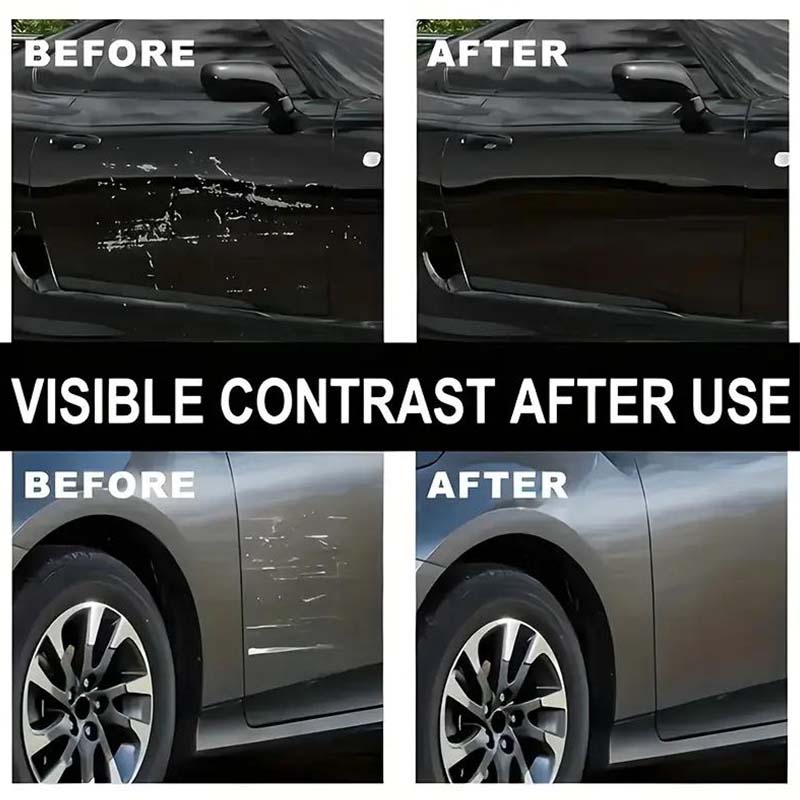
 BEFORE
AFTER CARE
BEFORE
AFTER CARE
THE RESULT TO LOOK FOR
Fine scratches scatter light and break up the reflection. Surface refinement helps the panel reflect more evenly, so the paint looks clearer, deeper and better maintained.

WHAT YOU NOTICE AFTER THE FINAL BUFF
Surface care is about how the entire panel reads in the light: fine marks become less noticeable, reflections look more even and the original color appears richer.

Shallow scratches and scuffs lose their harsh white edges, helping them blend more naturally with the surrounding finish.

Removing dull residue and refining the surface helps light travel across the panel with fewer cloudy interruptions.

After the residue is fully buffed away, the treated area feels cleaner and more uniform beneath a microfiber cloth.
Visible improvement varies with scratch depth, paint age, surface preparation and application. This product refines shallow clear-coat defects; it does not replace missing paint.
PREPARATION MATTERS
Use less product, lighter pressure and a clean surface. Controlled application produces a more even-looking finish than aggressive scrubbing.

Remove every trace of grit, dirt and road film. Work only on a clean, cool and completely dry panel.
Add a thin layer to the foam applicator. Using more product does not create a better result.
Work across the mark using small, controlled circular motions. Avoid aggressive scrubbing.
Remove residue with a clean microfiber cloth. Repeat lightly only when the surface still needs refinement.
USE THE RIGHT FIX
A focused hand treatment makes sense for surface defects. Missing paint and deep grooves need touch-up color or professional repair.
CUSTOMER RESULTS
Everyday surface marks, careful hand application and the difference a cleaner reflection can make.

“The light scuff looks much softer now, and the reflection across the door is noticeably more even.”

“The swirls around my door handle are far less distracting, and the gloss looks cleaner in daylight.”

“The treated spot feels smoother, and the dull patch blends much better with the rest of the panel.”
CLEAR ANSWERS BEFORE YOU START
Correct preparation, scratch-depth checking and light pressure matter more than using extra product.
Fine clear-coat scratches, wash swirls, minor scuffs, light paint transfer and dull surface haze are the best candidates. Results depend on scratch depth and paint condition.
Move a clean fingernail across the mark. If your nail catches in a groove, or if primer or metal is visible, the damage needs touch-up paint or professional repair rather than polishing wax.
The wax is color-neutral and intended for common gloss automotive paint. Test a small hidden area first. Do not use it on matte, satin, wrapped or freshly repainted surfaces unless the finish manufacturer approves polishing.
No. The routine is designed for hand application with a foam applicator and microfiber cloth. Light, controlled pressure is more important than speed.
Work in the shade on a cool, clean and dry panel. Direct sunlight and hot paint can make the product dry too quickly and become harder to buff evenly.
BETTER PREP. BETTER FINISH.
Check the depth, work on a cool clean panel and use controlled pressure to reveal a clearer, better-maintained finish.